

If you’ve ever tried to roll out “true” end-to-end email encryption across an enterprise, you probably remember the promise — and the pain. On paper, it’s the gold standard: encrypt on the sender’s device, decrypt only on the recipient’s, and keep everyone in the middle, including providers, blind to the contents.
In reality, most organizations that chase pure PGP/S/MIME-style end-to-end encryption either stall in pilots or quietly pivot to something more practical. The crypto works. The workflows don’t. That is the gap DataMotion is built to close: protecting sensitive information in motion while keeping the surrounding business process usable, auditable, and connected. Sensitive information does not move through a single inbox anymore. It moves through portals, CRMs, contact centers, shared service teams, automated notifications, document exchanges, and customer-facing applications. When encryption sits outside those workflows, users are forced to choose between staying secure and getting the work done.
This post looks at why that happens, what security teams are choosing instead, and how DataMotion’s approach — secure message centers, SafeTLS™, and embedded secure delivery APIs — delivers the outcomes organizations wanted from end-to-end encryption without breaking compliance, visibility, or customer experience.
The Ideal: What End-to-End Is Supposed to Do
In its strictest form, end-to-end email encryption means the message and its attachments are encrypted before they leave the sender’s device and can only be decrypted by the intended recipient’s private key. Servers, gateways, and even your email provider see only ciphertext.
Historically, that’s been implemented with technologies like PGP and S/MIME, or newer client-side encryption add-ins wired into Outlook or Gmail. For high-risk scenarios, that model still plays an important role.
But day to day, enterprises live in a different world: mixed devices, shared mailboxes, cloud archives, supervision rules, portals, and contact centers. Those environments need more than perfect math. They need visibility, continuity, and experiences people can actually navigate.
Where End-to-End Encryption Collides With Reality
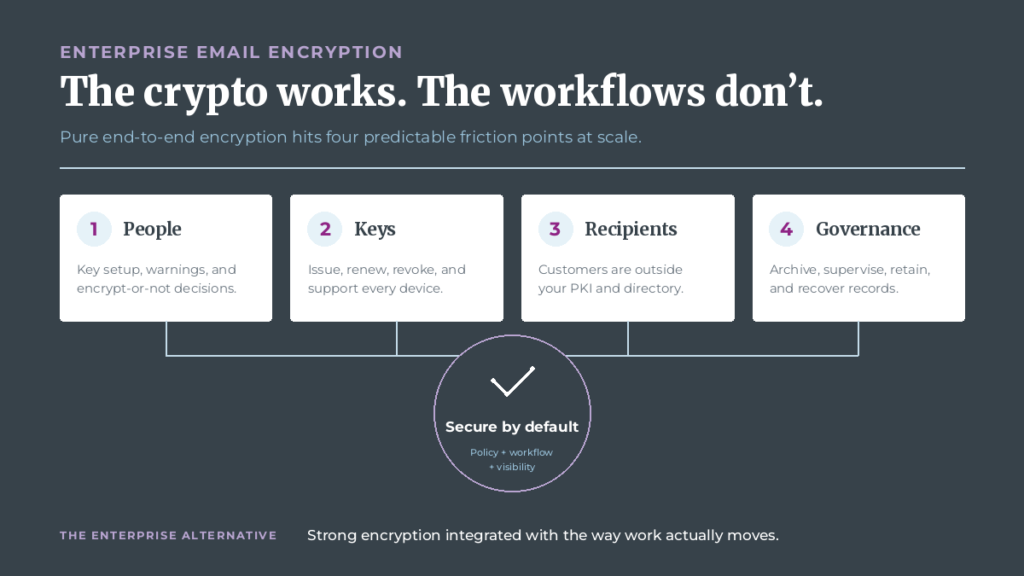
Usability: The First Thing to Break
Independent usability work has shown something uncomfortable: most people do not understand end-to-end email encryption tools, even when IT installs them. Users struggle with key creation, certificate errors, deciding when to encrypt, and interpreting warnings — so they either skip the tools or use them inconsistently.
For security teams, that’s the worst of both worlds. You carry the complexity and cost of end-to-end crypto, but the riskiest messages may still go out unprotected because the experience is too fragile to trust.
Certificate and Key Management at Scale
On the back end, S/MIME-style deployments demand a certificate or keypair for every user — and often every device. Security and IT teams have to issue, renew, and revoke certificates, sync with HR and identity systems when people move or leave, and support laptops, phones, and shared mailboxes that all need access.
At small scale, that’s tedious but manageable. At thousands of users and multiple business units, it becomes a permanent operational tax — and a real source of risk if anything is missed or misconfigured.
Your Customers Aren’t in Your PKI
End-to-end models also assume both sides are set up correctly. That’s rarely true once you leave your own directory. The people you care most about protecting — patients, policyholders, retail investors, citizens — do not typically have S/MIME certificates neatly installed on every device.
So teams end up bolting on one-time links, ad-hoc portals, and password-protected attachments. By that point, you’re no longer operating a clean end-to-end model. You’re juggling multiple delivery experiences and hoping users don’t get lost in the process.
Compliance, Archiving, and E-Discovery Still Exist
If you operate in a regulated industry, you don’t just need messages to be confidential — you need them to be findable, supervisable, and admissible years later. Pure user-held end-to-end encryption clashes with that requirement.
What happens when an employee with critical keys leaves? How do you journal, supervise, or apply AI-driven review if your archive can’t see message bodies at all? Most organizations that try to square this circle eventually introduce some form of key escrow or server-side recovery, quietly weakening the “only the endpoints can read this” ideal they started with.
What Security Teams Are Actually Standardizing On
If you zoom out and look at how mature enterprises are securing email today, a more pragmatic pattern emerges. The question shifts from “Do we have true end-to-end encryption?” to “Do we have strong encryption that plays well with policy, visibility, and real-world workflows?”
TLS Everywhere as Table Stakes
Transport Layer Security (TLS) between mail servers is the baseline: messages are encrypted in transit as they move from one provider to another, usually invisibly to end users. Organizations enforce TLS policies with partners where possible and treat it as the default posture for routine communication — while recognizing that TLS doesn’t protect against compromised accounts or exposed endpoints.
Policy-Driven Encryption at the Gateway
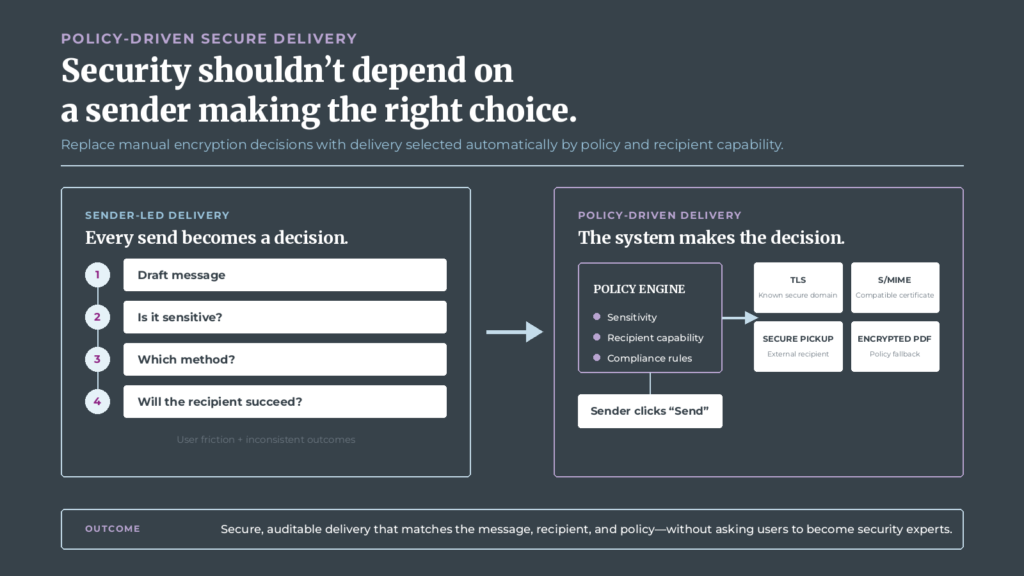
Instead of relying on senders to decide when and how to encrypt, modern secure email gateways and APIs inspect content and automatically choose the right delivery option: TLS, secure web pickup, encrypted PDFs, or S/MIME where appropriate.
DataMotion’s own email encryption selection guide reflects this evolution: today’s modern solutions centralize encryption, decryption, key handling, delivery methods, and tracking so business users can focus on the interaction, not the mechanics behind it.
Secure Message Centers for Real External Workflows
For recurring, high-value external workflows — onboarding, loan origination, claims, case management — many organizations are moving to secure message centers and portals. These provide a consistent, branded environment for messages and document exchange, with strong encryption in transit and at rest, and tight integration into CRMs, contact centers, and line-of-business systems.
In practice, this becomes secure data exchange, not just secure email: messages, files, forms, supporting documents, and workflow context can move through one governed experience instead of scattering across inboxes, portals, and one-off links.
DataMotion’s Secure Message Center is built around this model: a unified, web-based experience for encrypted messaging, document exchange, and workflow continuity that can be embedded into portals, CRMs, contact centers, and business applications. Staff and customers stay inside the tools they already use, while sensitive exchanges remain secure, trackable, and governed.
Provider-Native and Overlay Encryption
Cloud ecosystems have also matured. Microsoft 365 and Google Workspace now offer integrated encryption capabilities — from simple “encrypt” buttons to more advanced client-side encryption tied to labels and DLP policies. Overlay solutions add object-level encryption and access control, while giving security teams a central console for policy and audit.
These approaches are less dogmatic than classic end-to-end encryption, but they fit far better with long-term archiving, legal holds, supervisory review, and cross-ecosystem communication.
For Microsoft-centered organizations, DataMotion can extend that model beyond the inbox by embedding secure exchange into Microsoft 365, Outlook-driven workflows, Teams-connected processes, Dynamics, and other systems where regulated work actually happens.
The limitation is that native email encryption usually solves only part of the problem. Regulated workflows often extend beyond the inbox into portals, service teams, advisors, claims, clinical exchanges, and customer support environments. That is where a secure exchange layer like DataMotion becomes valuable.
Why Traditional E2EE Is Awkward in Regulated Environments
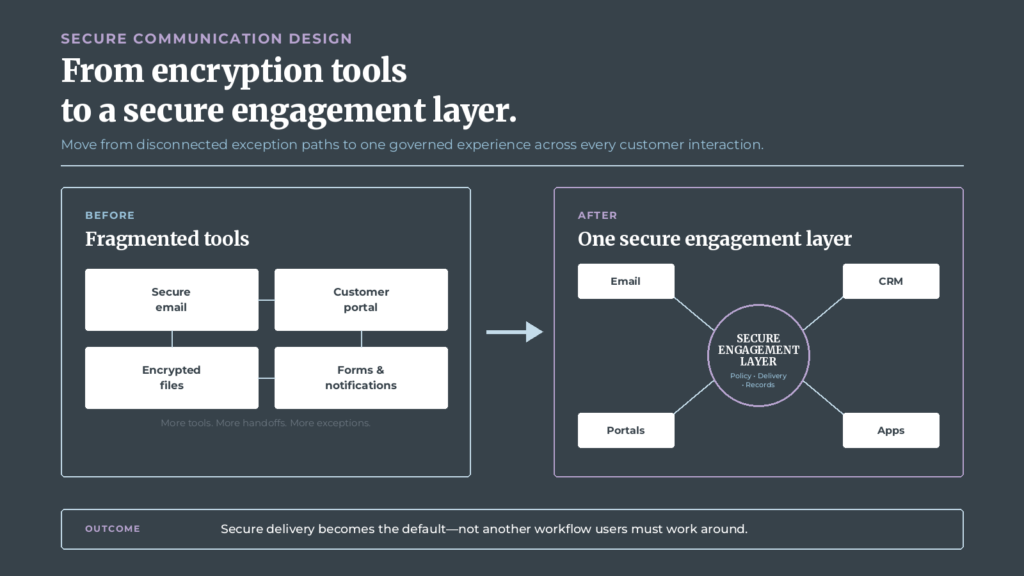
Regulated industries — financial services, healthcare, public sector — feel the friction even more acutely. Traditional encryption methods, when bolted on as standalone products, tend to create disconnected data silos, fragmented processes, and clunky user experiences.
Sensitive information ends up scattered across isolated secure email portals, password-protected attachments, and multiple encryption tools that don’t talk to each other. That fragmentation doesn’t just frustrate users; it opens up risk, as people work around controls just to get work done. The bigger issue is workflow continuity. A customer, patient, advisor, agent, or case worker may start in one channel and need to continue in another, with files, forms, messages, approvals, and records staying connected. Legacy encryption tools rarely support that kind of handoff cleanly.
By contrast, secure digital platforms and engagement layers aim to keep data encrypted in motion and at rest, maintain a coherent, auditable record of exchanges, and integrate smoothly with client portals, EMR/EHR systems, CRMs, and contact centers.
A More Useful Pattern: Secure Message Centers, SafeTLS™, and Embedded APIs
The organizations that have moved beyond purely theoretical end-to-end encryption and into sustainable practice tend to share a few design principles.
Make Encryption Invisible When You Can
The ideal state is “secure by default.” Encryption is applied by policy and integration, not by asking individual users to make cryptographic decisions. With approaches like SafeTLS, messages are automatically transmitted over encrypted channels when counterparties support them, and alternative secure delivery options are invoked when they don’t — without the sender having to think about it.
When Users See It, Make It Intuitive
There are moments when users should see that they’re doing something different: clicking “Send Secure,” opening a secure message center, or authenticating to view sensitive attachments. Those moments need to feel simple and familiar, not like a different universe.
In well-designed environments, secure messaging sounds suspiciously like regular email from the user’s perspective — except messages and documents are encrypted in transit and stored securely, and the experience is integrated with the web and mobile applications they already trust.
Govern With Policy, Not Heroics
Finally, controls should be centralized. Security and compliance teams define policies once — what to encrypt, where it can go, who can see it, how long it is retained — and the platform enforces those rules consistently across channels.
That’s where the DataMotion Platform comes together:
- Secure Email Exchange and SafeTLS automatically apply encryption to emails and attachments, selecting the safest available delivery method based on policy, recipient capability, and business need.
- Secure Message Center provides a hub for secure two-way messaging, document exchange, and workflow continuity, embeddable into portals, CRMs, and applications so high-value interactions happen in one governed place.
- Secure delivery APIs and Microsoft integrations extend the same secure exchange model into automated notifications, application workflows, Outlook, Microsoft 365, Teams-connected processes, Dynamics, contact centers, and other enterprise systems.
The net effect: you realize most of the benefits that originally drove interest in end-to-end encryption — confidentiality, integrity, and trust — while gaining the governance, visibility, and user experience you need to operate at enterprise scale.
How to Pressure-Test Your Current Approach
If you’re responsible for security, risk, or compliance, it’s worth asking a few blunt questions about your current email encryption posture:
- Are our “secure email” tools simple enough that our riskiest users and recipients actually use them?
- Do our supervision, legal, and records teams have the access they need without undermining security?
- Where are we forcing customers or members into awkward one-off experiences instead of meeting them inside the portals and apps they already use?
- Are we managing point products, or are we moving toward a unified secure engagement layer?
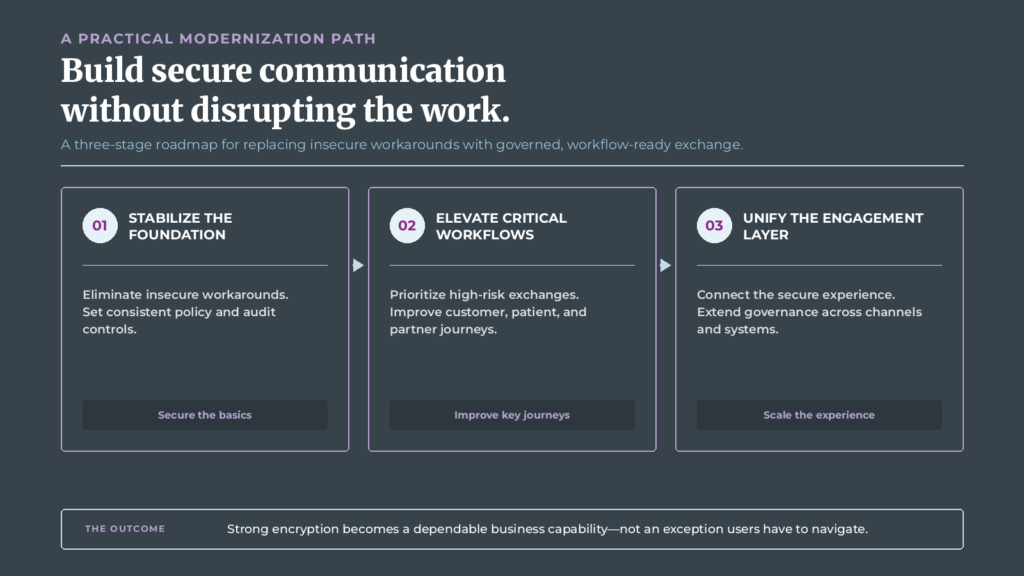
A practical roadmap often looks like this:
- Stabilize the foundation. Enforce TLS aggressively, tighten policy-driven encryption at your gateways, and make “secure by default” the normal experience for senders.
- Elevate critical workflows. Identify the top external workflows where sensitive data moves today — claims, account servicing, onboarding, clinical exchanges — and move them into a secure message center integrated with your portals, CRMs, and contact centers.
- Unify into a secure engagement platform. Over time, converge email encryption, secure messaging, secure forms, document exchange, and automated delivery onto a single secure engagement layer, so policies, reporting, audit trails, and AI-assisted workflows all operate on one governed view of sensitive data in motion.
End-to-end email encryption promised a lot. In 2026, the organizations that are actually winning with secure communication are the ones pairing strong encryption with integrated workflows, centralized policy, and a recipient experience that people don’t fight.
If you’re ready to move past theoretical end-to-end encryption and toward a secure engagement model that matches how your business really runs, DataMotion can help map the path forward, from tightening email encryption today to embedding secure, compliant data exchange across the portals, Microsoft tools, CRMs, contact centers, and applications your teams already rely on.
References
- Google Search Central, Creating helpful, reliable, people-first content
- Microsoft Learn, Email encryption in Microsoft 365
- Peer-reviewed research, Usability of End-to-End Encryption in E-Mail Communication
- DataMotion, Secure Message Center
- DataMotion, Email Encryption and Document Exchange, Reimagined
Frequently Asked Questions
What is end-to-end email encryption?
End-to-end email encryption protects the content of a message and its attachments so that only the intended sender and recipient can read them. The message is encrypted before it leaves the sender’s device and can only be decrypted with the recipient’s private key, so intermediaries such as email providers see only encrypted data.
Why is end-to-end email encryption hard to deploy at enterprise scale?
Large organizations struggle with end-to-end email encryption because it depends on complex certificate and key management, training every user to handle keys correctly, supporting external recipients who are not in the same system, and still meeting archiving, supervision, and e-discovery requirements.
Is end-to-end email encryption enough for regulated industries?
No. While end-to-end encryption protects message content, regulated financial services, healthcare, and public sector organizations also need centralized records retention, supervision, and workflow visibility, which pure user-held key models do not provide on their own.
What are the alternatives to traditional end-to-end email encryption?
Most enterprises rely on a combination of TLS for transport security, policy-driven encryption gateways, secure message centers or portals for document-heavy workflows, and integrated encryption features from cloud email providers like Microsoft 365 and Google Workspace.
How does a secure message center improve on legacy email encryption tools?
A secure message center provides a web-based environment for two-way messaging and document exchange that is encrypted in transit and at rest, with full tracking and access controls. Instead of relying on plug-ins, it integrates with portals, CRMs, and contact centers so customers and internal teams can work in a single, continuous interaction.
Where does DataMotion fit in an enterprise email encryption strategy?
DataMotion acts as a secure engagement and data exchange layer across existing email, Microsoft 365, CRM, portal, and contact center environments. Its SafeTLS transport encryption, secure message center, and secure delivery APIs protect sensitive data in motion while supporting compliance, archiving, and better customer and advisor experiences across regulated workflows.
Can DataMotion work with Microsoft 365, Google Workspace, and contact centers?
Yes. DataMotion integrates with Microsoft 365 and Outlook, complements existing cloud email environments, and connects to CRMs, portals, contact centers, and business applications through APIs and low-code options so secure exchanges stay embedded in the tools teams already use.
About the Author
Anne Marie Murray
Anne Marie Murray is Head of Marketing at DataMotion, where she leads brand, demand generation, product marketing, partner marketing, and go-to-market strategy. With more than 20 years of experience in B2B technology and SaaS, she brings deep expertise in translating complex enterprise products, secure communications, and regulated-industry workflows into clear market strategies and measurable business value. Her background spans market research, positioning, product launches, sales enablement, AI-enabled marketing, and revenue growth. As a member of DataMotion’s leadership team, Anne Marie partners across product, sales, and engineering to turn customer insight, market opportunity, and technical capabilities into strategies that strengthen adoption, pipeline, and long-term growth.