

In the healthcare industry, data is everything. From research to treating patients, having the right data to work with is critical. However, when patients need to see different doctors or specialists to receive treatment, exchanging information can become confusing.
This is where HISPs come in. A HISP is an entity or organization that facilitates secure health information exchange. HISPs provide the necessary infrastructure, standards and services to enable healthcare organizations, providers and systems to share health-related data securely. In other words, they make the exchange of patient information easier than ever.
Keep reading to understand how HISPs work, why they matter in healthcare data exchange, and how Direct Secure Messaging supports secure, compliant communication at scale, or jump to a specific insight:
- Defining HISPs and Their Fundamental Purpose
- The Inner Workings of HISPs
- Health Information Exchange Systems
- The Role of HISPs in Healthcare and Patient Data Protection
- What is Direct Secure Messaging and How Do HISPs Power It?
- How HISPs Improve Healthcare Communication and Data Exchange at Scale
- How APIs Extend the Value of HISPs
- Contact DataMotion Today for HISP Services
Defining HISPs and Their Fundamental Purpose
What does the acronym “HISP” stand for? It means “health information service provider.” The term HISP is often used when discussing Direct Secure Messaging. HISPs facilitate the safe exchange of data and information between healthcare organizations. Some of the most valuable benefits of using a HISP include:
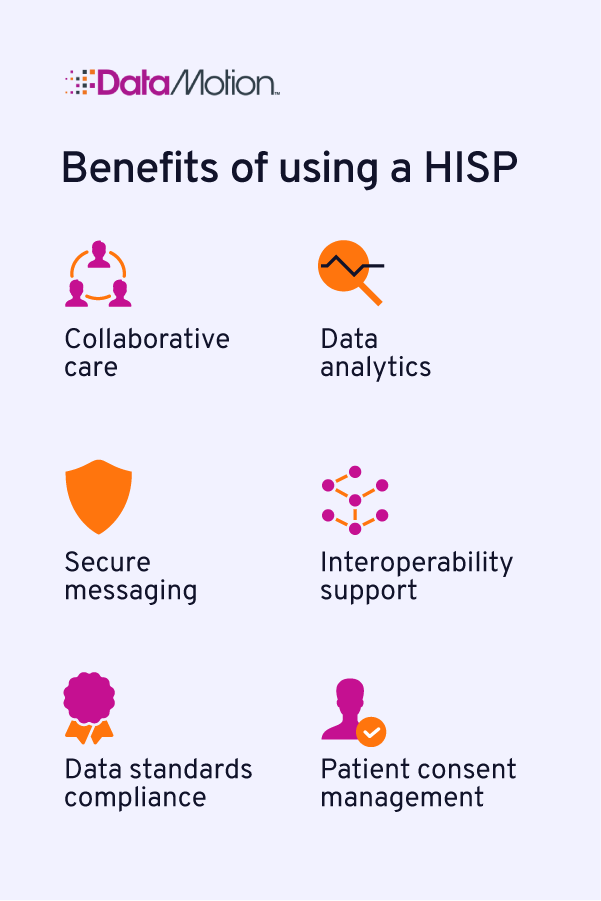
- Collaborative care: When patients need treatment from other providers and specialists, the relevant healthcare professionals can send their information and medical history accordingly. Additionally, professionals can log patient health information to shared systems like health information exchanges (HIEs), allowing healthcare providers to access common health records.
- Data analytics: The healthcare industry is constantly producing valuable data. HISPs make it possible to collect and analyze health data to reduce healthcare costs and manage the health of a population.
- Secure messaging: HISPs enable secure messaging services that allow healthcare entities to exchange protected health information while ensuring data privacy and compliance with health information security standards at scale.
- Interoperability support: HISPs help achieve interoperability with health information exchanges across different healthcare systems, electronic health records (EHR) platforms and other health-related applications.
- Data standards compliance: HISPs ensure data exchanged follows standardized protocols and data standards promoting consistency and compatibility.
- Patient consent management: HISPs often include mechanisms for managing patient consent preferences for sharing health data.
The Inner Workings of HISPs
HISPs work by allowing health plans, doctors, practices and hospitals to exchange health information. A HISP’s primary function is to manage the security and sharing of patient healthcare data. HISPs that participate in the DirectTrust™ network are accredited and governed under DirectTrust’s trust framework. This framework aligns with federal interoperability and privacy requirements overseen by the United States Department of Health and Human Services (HHS) and the Assistant Secretary for Technology Policy and Office of the National Coordinator for Health Information Technology (ASTP/ONC).
HISPs offer cost-effective, rapidly deployed services that comply with health information-sharing regulations. A HISP provides a standards-based, auditable exchange layer that replaces manual point-to-point methods like fax and virtual private networks (VPNs) with governed, interoperable messaging. These healthcare providers also offer access to the DirectTrust network. This network allows trading partners to perform a health information exchange via the internet.
Health Information Exchange Systems
HISPs often serve as a critical connectivity layer within broader health information exchange (HIE) strategies, enabling secure data movement between organizations even when they operate on different systems.
An electronic HIE aims to improve the interoperability and accessibility of patient information across different healthcare organizations. It gives doctors, nurses and other healthcare professionals secure access to patient’s protected health information.
These systems can significantly improve the completeness of a patient’s records, which has a significant impact on the care they receive. The more information healthcare providers have about the patient, the more thorough they can be, resulting in better quality of care for the patient. This includes the patient’s past and current diagnostics, medications, and other health data that could improve patient outcomes and make it easier to treat them and identify an issue.
By using an HIE to share patient information promptly, doctors will have better information and avoid readmissions and errors. If a patient is allergic to something or responds more favorably to a specific type of treatment, that patient information would be readily available to the care provider.
The Role of HISPs in Healthcare and Patient Data Protection
HISPs offer healthcare organizations (hospitals, physicians, health plans, health information exchanges) and consumers an onramp to the Direct Secure Messaging network, where trading partners can exchange protected health information (PHI) in a structured and unstructured format across the internet with maximum security and privacy.
By enforcing identity verification, certificate management, and trust policies, HISPs help healthcare organizations exchange PHI confidently across large, distributed care networks.
Exchange partners can easily find each other on the DirectTrust network through a healthcare provider directory (HPD), promoting fast collaboration and interoperability in sharing patient information.
What is Direct Secure Messaging and How Do HISPs Power It?
Direct Secure Messaging is the primary service model through which HISPs deliver trusted, point-to-point healthcare communication.
This nationwide messaging service delivered by HISPs and overseen by DirectTrust represents a modern, affordable, and standards-based alternative to sharing clinical data by fax, virtual private networks, and proprietary interfaces. The latter health information exchange methods are costly and increasingly outmoded as healthcare providers embrace digital communications with the economies, scale, and ubiquity of the internet. Operationally, HISP-delivered Direct Secure Messaging services are most closely related to fax in that both methods “push” health data between senders and recipients and return a delivery notification upon completion.
Collectively, HISPs are the communications backbone of the DirectTrust protected health information exchange. Individually, they are access points to the DirectTrust network and are referred to as DirectTrust network service providers or Direct Trusted Agents. Direct Secure Messaging, Direct exchange, ONC Direct, and HISP services are the terms generally used to describe the clinical data exchange service HISPs provide.
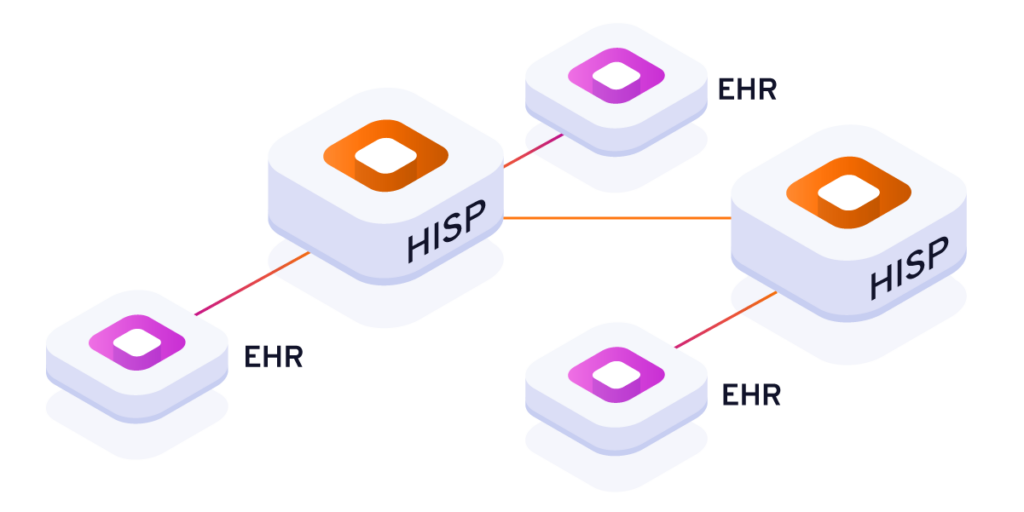
Because the electronic medical record message attachments (HL7 C-CDAs or CDA) processed by HISPs meet Health IT interoperability standards, PHI exchanged via Direct Secure Messaging can be sent and received from EHR workflows. The same standard allows health data sharing among any EHR and any software solution connected to a HISP. To use email as an analogy, you may have Microsoft Outlook installed on your computer, but if it isn’t connected to an email network, your emails can’t go anywhere, and none can get to you. Similarly, your EHR can send and receive Direct-compliant messages, but those messages won’t go anywhere unless you and those who you are communicating with have valid HISP service, addresses and DirectTrust certificates.
For Health IT developers seeking ONC/EHR Certification, HISPs are important partners. HISPs provide certification requirements related to Direct Secure Messaging that are out of scope for most developers, enabling them to meet and satisfy Certification requirements.
How HISPs Improve Healthcare Communication and Data Exchange at Scale
Some HISPs are end-user-facing with recognizable brand names and user interfaces while others operate behind the scenes as an integrated module of an EHR or similar health IT solution. Those that tightly integrate with EHRs or HIEs are sometimes owned and operated by the solution vendor and provide a captive service tailored to the solution. Independent (aka: pure-play) HISPs are typically full-service providers offering a range of connectivity and service options to suit the needs of a range of end-user requirements.
To support healthcare communication at scale, HISPs deliver a set of tightly governed sub-services that extend beyond the basic Direct Secure Messaging service, including:
- Direct Secure Messaging Addresses
Direct addresses are similar to typical email addresses with the exception that they operate exclusively on the DirectTrust network. DirectTrust network operators recognize the specialized digital certificate affixed to a Domain/Direct Address and can only be issued by an accredited DirectTrust HISP. The digital passport represented by the certificate makes Direct addresses unique from Gmail, Outlook, Yahoo, and similar addresses that operate on standard email. The Certificate also encrypts messages and confirms the identity of the sender and receiver, resulting in non-repudiation. - DirectTrust Onramp Connectivity Options
- Edge protocols (eg: XDR or S/MIME)
- Web-based mail portal with accessibility support
- Protocol transformation and routing: SMIME/SMTP, IHE XDR, web services
- Digital Certificate Issuance and Live Cycle Management
- The DirectTrust-authorized digital certificates provisioned by HISPs require specialized management and sharing capabilities that only HISPs are qualified to provide.
- Participation in the DirectTrust Accredited bundle
- Certificate issuance and registration authority
- Identity Authentication (aka: identity proofing)
- To keep the DirectTrust network clean of bad actors (e.g: spammers), HISPs are required to confirm the true identity of participants in Direct Messaging prior to provisioning a Direct Address
- Message Delivery Notification
- Message completion acknowledgements collected and reported out by HISPs are considered to be irrevocable proof of message delivery and thus have important weight in legal and CMS reporting
- Direct Secure Messaging Service Support
- Online and phone support for onboarding, connectivity issues and outages, and other service needs
- High-availability and disaster recovery
- Healthcare Provider Directory (HPD)
- Publish Direct Addresses to DirectTrust HPD
- Enforcing DirectTrust Rules of the Road
- Maintain accreditation attesting to trust relations
- Security and Trust Framework
The most notable benefits of using Direct Secure Messaging in healthcare include:
- Reduced administrative costs: Secure messaging is a cost-effective solution and does not need manual processing. It’s easier to share information and can be done without needing extra staff members. This process saves time by cutting down on paperwork, which allows healthcare workers to spend more time caring for their patients.
- Improved patient experience and care coordination: Healthcare centers, clinics, hospitals and practices that use secure messaging can provide patients with better experiences. Patients can now communicate more effectively and much faster with their healthcare providers. They no longer need to wait hours in a waiting room or make unnecessary trips to doctors or specialists. A more complete picture of patient health history drives a better quality of care and patient outcomes.
- Operational efficiency across care workflows: Security and efficiency are the two most important factors when dealing with healthcare information. Secure messaging embodies both of these factors. It allows for easy and highly secure communication between patients and healthcare providers. This system makes it convenient for the patients and greatly reduces time spent on administration.
- Enhanced privacy and data protection: Healthcare providers and information sharing need to be taken seriously. Sensitive patient information needs to be well-protected. This information includes medical records, prescriptions and test results. Secure messaging protects this health data through two-factor authentication, ensuring only the right people can access it. Encryption ensures protected health information from cyber threats and lowers the risk of identity theft. Using secure messaging in healthcare allows practitioners to trust their patient’s information is safe.
How APIs Extend the Value of HISPs
API stands for “application programming interface.” This software intermediary allows two applications to talk to each other and allows users to integrate various automation tools. Using an API can reduce administrative costs and boost efficiency. With automation, the amount of manual processing required is greatly reduced. From handling patient scheduling to grouping information together, automation and API can significantly enhance the efficiency and uses of a HISP.
Real-time data available through an API can be an excellent source for reliable data analysis and generating real-time insights. Aside from helping patients receive better care, APIs help providers give them the best patient experience possible. Modern HISPs expose APIs that allow healthcare systems to integrate secure messaging, identity services, and delivery status directly into EHR and clinical workflows.
Contact DataMotion Today for HISP Services
As a DirectTrust accredited HISP, DataMotion supports large healthcare organizations with secure, scalable Direct Secure Messaging infrastructure built for reliability, governance, and interoperability. Explore our healthcare solutions or request a demo to see how we support secure data exchange across complex healthcare systems.
Frequently Asked Questions
What is a HISP?
A HISP, or Health Information Service Provider, is an organization that enables the secure exchange of health information using Direct Secure Messaging. It handles the encryption, trust, and delivery that let healthcare participants share data safely.
What does a HISP do?
A HISP manages the secure transport of Direct messages, verifies the identity of participants, and ensures messages are encrypted and delivered only to trusted recipients.
Why is a HISP important in healthcare?
HISPs make it possible for providers, health plans, and partners to exchange protected health information securely, which supports care coordination and interoperability requirements.
How is a HISP related to Direct Secure Messaging?
Direct Secure Messaging is the standard for secure health data exchange, and a HISP is the service that makes it work by handling identity, encryption, and message delivery between trusted parties.
Does DataMotion operate as a HISP?
Yes. DataMotion operates as a HISP, enabling healthcare organizations to send and receive Direct Secure Messages securely.