
In an era where patient information is both abundant and sensitive, the secure and efficient exchange of health data is no longer optional – it’s a necessity. With ongoing changes in government policies, healthcare organizations are under constant pressure to ensure compliance while seamlessly sharing data with multiple partners and public health agencies. This piece explores the latest trends in healthcare data exchange and showcases how forward-thinking solutions are addressing these challenges head-on.
The Evolving Demands of Healthcare Data Exchange
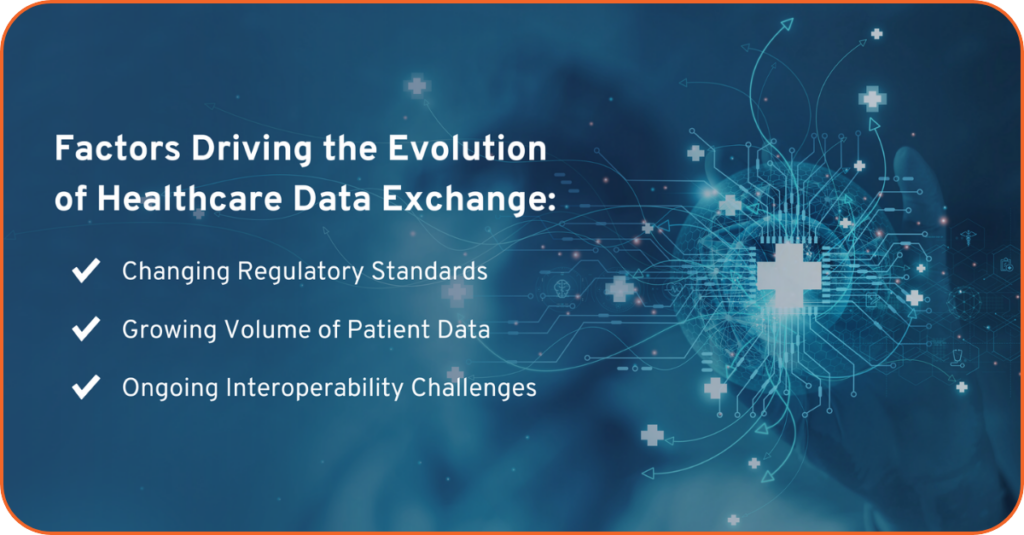
Healthcare organizations are increasingly tasked with exchanging more patient information than ever before. This growing demand is driven by several factors:
- Regulatory Changes: Government policies are evolving rapidly, necessitating frequent updates to data exchange protocols. Evidence of this can be seen in the industry’s ongoing commitment to improving data sharing and strengthening access to care. Additionally, the nationwide health data exchange governed by the Trusted Exchange Framework and Common Agreement (TEFCA) is now operational, marking a significant milestone for health data interoperability.
- Data Volume: The sheer volume of patient data is expanding. According to RBC Capital Markets, healthcare-related information now makes up 30% of the world’s data. This vast volume of data necessitates a robust infrastructure capable of handling large-scale exchanges. It’s no longer about just managing data; it’s about doing so efficiently and securely.
- Interoperability: There is a pressing need for interoperability among diverse healthcare IT systems. Despite progress in health information exchange, challenges remain. For example, the Office of the National Coordinator for Health Information Technology (ONC) found that nearly half of hospitals experience one-sided data-sharing relationships, where they share patient information with other providers but don’t receive any in return. This imbalance highlights the ongoing struggle for true interoperability.
Key Components of Modern Healthcare Data Exchange
Embracing Scalability to Meet Growing Needs
As the volume of patient data expands, scalability emerges as a critical concern. Healthcare organizations must invest in scalable solutions that can effectively handle high-capacity data exchanges. These solutions must be capable of processing millions of records per day while upholding stringent security standards.
Public Health Organizations, Health Information Exchanges (HIEs), and Health Information Networks (HINs) are particularly in need of these platforms. Due to the large amounts of data that they manage and share across multiple healthcare entities, scalability is not just a preference but a necessity.
The Imperative of Advanced Security and Compliance
In an age where data breaches and cyber threats are rampant, the healthcare sector cannot afford to compromise on security. Advanced security measures, including military-grade encryption and zero-trust security models, are essential. Compliance with regulations such as HITRUST CSF®, GDPR, SOX, and PCI-DSS is not optional; it’s a critical requirement. By meeting these standards, healthcare organizations not only protect sensitive patient information but also build trust with patients and partners alike.
Enhancing Interoperability and Integration
The true potential of healthcare data exchange is realized through seamless integration and interoperability. Innovative solutions are designed to integrate effortlessly with existing healthcare IT infrastructure, including Electronic Health Records (EHR) and Electronic Medical Records (EMR) systems. This level of integration extends to other critical systems within urgent care, extended care facilities, and home care, ensuring a unified and efficient workflow. When these systems can communicate with one another, it enhances patient outcomes and workflow efficiency.
Advanced Features for Efficient Healthcare Communication
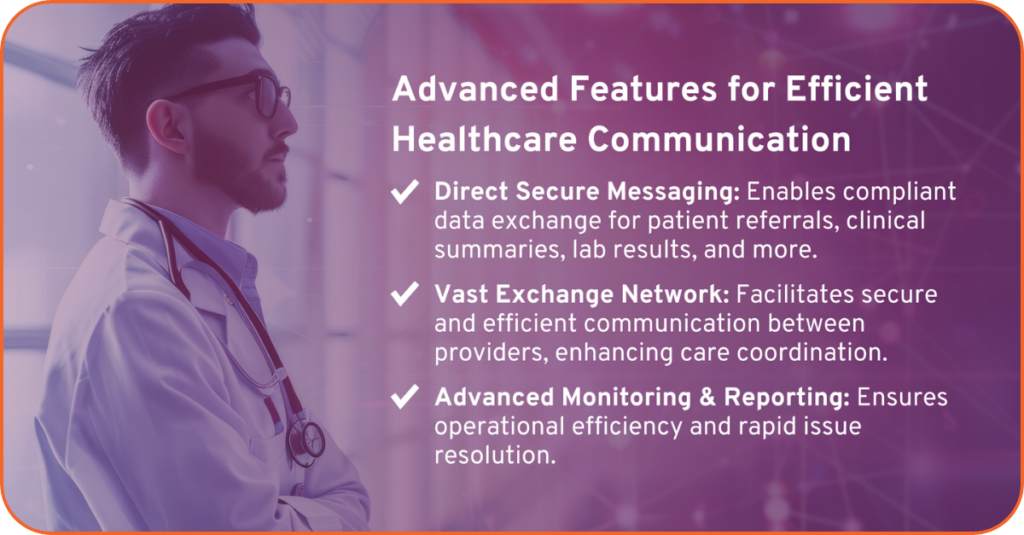
Direct Secure Messaging: A Cornerstone of Healthcare Communication
Secure communication of Protected Health Information (PHI) is a cornerstone of effective health data exchange. Direct Secure Messaging, a service facilitated by Health Information Service Providers (HISPs), offers providers a secure, email-like interface to exchange vital information such as patient referrals, clinical summaries, and lab results. Utilizing advanced encryption techniques ensures that this sensitive information remains confidential and compliant with regulatory standards.
Leveraging a Vast Exchange Network
Access to an extensive directory of trusted addresses is crucial for efficient healthcare communication. A comprehensive network that includes millions of DirectTrust™ and National Provider Identifier (NPI) addresses across hundreds of thousands of organizations facilitates secure and efficient communication between providers, ultimately enhancing patient care coordination.
The Role of Advanced Monitoring and Reporting
Effective data exchange solutions offer more than just basic functionality; they provide advanced reporting and monitoring capabilities. Detailed message tracking, comprehensive system performance views, and 24/7 monitoring and support are essential features that contribute to operational efficiency and rapid issue resolution.
Driving Reliability and Efficiency in Healthcare Data Systems
Ensuring Reliable Clinical Availability
Continuous data availability is critical in healthcare. Solutions that offer high reliability, with built-in redundancy and fail-over systems, ensure uninterrupted patient care. A 99.9% uptime guarantee is not just a benchmark but a necessity for healthcare organizations relying on consistent data access.
Streamlined Workflow Integration
To truly revolutionize healthcare data exchange, solutions must support both clinical and non-clinical workflows through full lifecycle integration. Utilizing RESTful APIs and protocols, these solutions enable rapid scalability, automated provisioning, and efficient user management, significantly improving operational efficiency.
What the Future Holds for Healthcare Data Exchange
Innovating for Enhanced Healthcare Communication
The future of health data exchange is being shaped by innovative features that are changing how healthcare providers communicate and share information. These advancements include:
- Electronic Case Reporting (eCR): Facilitates fast and secure health data exchange.
- Event Notifications (ADT): Ensures timely alerts about patient admissions, discharges, and transfers.
- Patient Referrals: Enables seamless data transmission between providers.
- Closed-loop Referrals: Enhances care coordination through real-time data exchange and feedback.
These capabilities are not just improving efficiency; they’re transforming the landscape of patient care. By enabling faster, more secure, and more comprehensive data sharing, these innovations are paving the way for more coordinated and effective healthcare delivery. As these technologies evolve, we can expect to see even greater integration of healthcare systems, leading to improved patient outcomes and a more responsive healthcare ecosystem.
Pioneering the Future of Healthcare Data Exchange
As healthcare continues to digitize and data volumes expand, innovative solutions that combine scalability, security, and interoperability will be instrumental in advancing patient care and operational efficiency. DataMotion, with its high-capacity population scale HISP services, exemplifies this innovation. By offering scalable infrastructure, advanced security measures, seamless integration, and comprehensive communication features, DataMotion enables healthcare organizations to navigate the complexities of modern data exchange. Embracing these cutting-edge technologies, healthcare providers can position themselves at the forefront of the industry, ensuring better patient outcomes and improved efficiency.
Have questions about how to implement effective data exchange solutions in your organization? Contact us to get in touch with one of our experts.
Frequently Asked Questions
What is a high-capacity HISP and why does healthcare need one?
A HISP (Health Information Service Provider) facilitates Direct Secure Messaging. A high-capacity, population-scale HISP can process millions of records per day while upholding strict security, meeting the needs of Public Health Organizations, HIEs, and HINs that manage large data volumes across many entities.
What is driving the growing demand for healthcare data exchange?
Three key factors: rapidly evolving regulations such as the now-operational TEFCA framework; expanding data volume, with healthcare making up 30% of the world’s data; and persistent interoperability challenges, since nearly half of hospitals report one-sided data-sharing relationships.
What features should a modern healthcare data exchange solution offer?
Scalability to handle high-capacity exchanges, advanced security including military-grade encryption and zero-trust models, compliance with standards like HITRUST CSF, seamless EHR/EMR integration, Direct Secure Messaging, access to a vast trusted address network, and advanced monitoring with 24/7 support.
What future innovations are shaping healthcare data exchange?
Emerging capabilities include Electronic Case Reporting (eCR), Event Notifications (ADT) for admissions, discharges, and transfers, patient referrals, and closed-loop referrals. These enable faster, more secure, and more comprehensive data sharing for better care coordination and patient outcomes.