

What are ADT Data Analytics? In healthcare, ADT data analytics refers to the analysis of admission, discharge, and transfer (ADT) event data to track patient movement across care settings in real time. Healthcare organizations use ADT analytics to improve care coordination, identify high-risk patients, support compliance, and optimize operational and financial performance.
At scale, ADT data analytics depends on reliable, standardized data exchange across systems, organizations, and care settings—not just individual point-to-point connections.
Admission, discharge, and transfer (ADT) event notifications play a crucial role in care coordination, patient monitoring, and operational efficiency. While many healthcare organizations recognize the value of real-time patient data alerts, managing ADT notifications effectively—particularly across diverse and decentralized networks—remains a challenge.
As the industry evolves, harnessing secure patient data transmission through advanced ADT analytics can provide deeper insights into patient care, streamline hospital operations, and enhance financial performance. However, to fully capitalize on these benefits, organizations must address critical challenges in healthcare information exchange, data security, and HIPAA-compliant data exchange while implementing best practices for interoperability in healthcare data systems.
Keep reading to learn more about ADT Data Analytics and their role in real-time patient care and data-driven decision making, or jump to a specific insight:
- How Can ADT Data Analytics Improve Patient Outcomes?
- Why Is Transmitting ADT Notifications Across Diverse Networks So Challenging?
- Best Practices for Managing ADT Notifications
- What the Future of ADT Data Analytics Means for Healthcare Organizations
- Final Thoughts
- Frequently Asked Questions About ADT Data Analytics
How Can ADT Data Analytics Improve Patient Outcomes?
ADT notifications provide real-time visibility into patient movement across healthcare facilities, allowing organizations to:
- Enhance care coordination by ensuring all providers in a patient’s care journey are informed.
- Identify high-risk patients by integrating ADT data into predictive analytics models to prioritize follow-up care.
- Optimize hospital operations by improving patient flow and Electronic Health Records (EHR) integration.
- Improve financial management through better control of utilization and length of stay.
When implemented using guideline-based ADT practices, organizations see measurable improvements in follow-up timeliness, reduced readmissions, and more consistent care transitions, directly impacting patient outcomes. These improvements are most consistent when ADT data is delivered through scalable, governed exchange models that support high message volumes and multi-entity coordination.
While healthcare data management has improved, organizations still face hurdles when optimizing patient data flow between providers, particularly when operating outside of centralized networks.
➔ Understand the importance of effective ADT event notifications. Read our blog post to explore their purpose and learn the key information you need to include.
Why Is Transmitting ADT Notifications Across Diverse Networks So Challenging?
Many healthcare organizations work across multiple systems and networks, leading to complexities in ADT data exchange. While hospitals are required by CMS regulations to send ADT event notifications under Medicare Conditions of Participation (CoPs), other healthcare entities—such as skilled nursing facilities, outpatient providers, and care coordinators—often receive but are not required to send ADT notifications.
As participation expands beyond hospitals, traditional point-to-point integrations become increasingly difficult to manage and govern. This fragmentation is why many healthcare providers struggle with incomplete visibility across patient transitions, even when ADT notifications are technically being sent. Likewise, the variation in participation adds to the complexity of secure patient data transmission, regulatory compliance, and interoperability.
What Are the Biggest Barriers to Optimizing ADT Data Analytics?
These barriers rarely exist in isolation. At enterprise scale, fragmented security models, inconsistent interoperability, and manual workflows compound operational risk and slow care coordination.
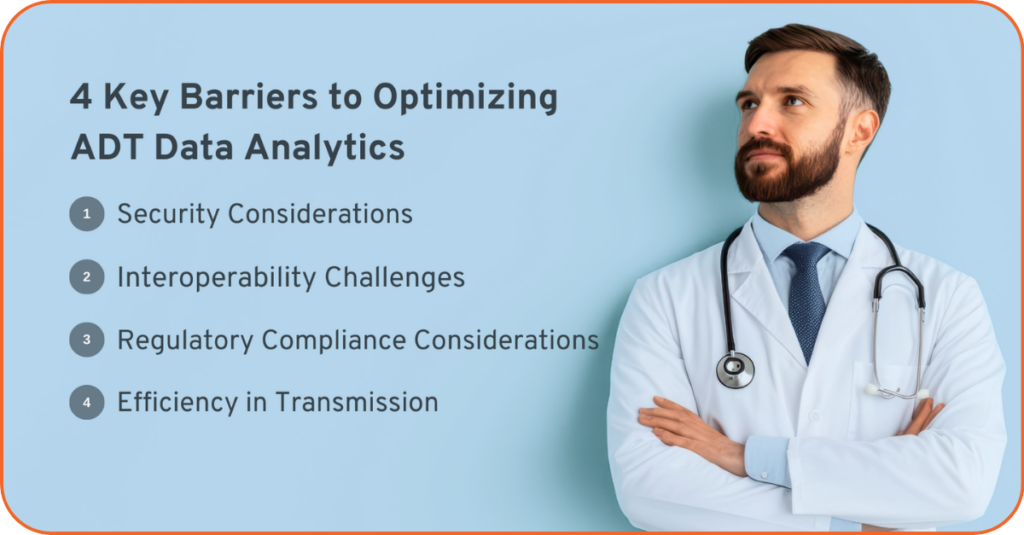
1. Security Considerations
For organizations that operate outside of a unified healthcare data management framework, ensuring secure ADT notification transmission can be challenging. Many healthcare providers rely on Virtual Private Networks (VPNs) and Secure FTP (SFTP) to facilitate data exchange, each with its own security and operational trade-offs:
- VPNs create encrypted tunnels for secure patient data transmission, protecting against unauthorized access. However, they require significant IT resources for setup, monitoring, and ongoing maintenance to remain HIPAA-compliant and ensure seamless interoperability between different systems.
- SFTP allows for secure file transfers, but organizations must implement manual configurations, access controls, and continuous workflow monitoring to maintain security and compliance.
Without a centralized trust framework, organizations must independently ensure auditability, message integrity, and regulatory compliance. This decentralized approach increases overhead and makes it harder to enforce consistent governance as networks grow.
For those leveraging a more standardized approach, DirectTrust™-accredited messaging networks offer a proven interoperability framework that can simplify secure ADT notification delivery. However, for organizations that choose not to participate in DirectTrust, alternative secure messaging and data exchange solutions can also support secure, HIPAA-compliant ADT transmissions without requiring full network participation.
2. Interoperability Challenges
While HL7 v2 remains the dominant standard for ADT notifications, and FHIR adoption is increasing, different EHR integration vendors interpret and implement them inconsistently, causing compatibility issues:
- ADT notifications from different systems may use inconsistent data formats, leading to processing errors, delays, or lost notifications that hinder care coordination.
- Many healthcare organizations have built custom integrations to ensure ADT notifications route correctly. While effective in limited scenarios, these custom integrations are difficult to scale, monitor, and adapt as data volumes and participants increase.
These inconsistencies make it difficult to manage ADT discontinuation and monitoring transitions when patients move between care settings.
3. Regulatory Compliance Considerations
While hospitals must comply with CMS regulations, other providers need strong security and compliance frameworks to exchange ADT data safely:
- Encryption, role-based access, and audit logging are essential for meeting HIPAA and state privacy law compliance.
- Compliance efforts can be resource-intensive, especially for organizations managing secure ADT transmissions independently without a centralized security framework.
4. Efficiency in Transmission
Hospitals using centralized networks experience smoother ADT delivery, while organizations relying on VPNs or SFTP configurations may face transmission delays:
- Manual configurations for FTP/SFTP can slow data exchange, increasing administrative workload and delaying critical interventions.
- Many organizations automate SFTP transfers, but ensuring real-time message delivery through SFTP remains a challenge.
In value-based care models, timely ADT notifications are essential for improving patient outcomes and avoiding unnecessary hospital readmissions. When those notifications are delayed or missed, they directly undermine automated alerting strategies designed to improve compliance and reduce avoidable readmissions.
➔ To ensure your ADT notifications are transmitted securely and in compliance with CMS requirements, explore our guide on best practices for ADT event notifications.
How Healthcare Organizations Can Manage ADT Notifications More Effectively
Addressing these challenges demands an approach designed to scale across networks, workflows, and compliance requirements—without introducing new operational complexity.
To do this, healthcare organizations need secure healthcare messaging solutions that balance flexibility, security, and compliance while ensuring seamless interoperability across systems. For organizations operating outside of standardized networks, this means choosing adaptable solutions that can securely manage real-time ADT notifications without introducing additional administrative burden.
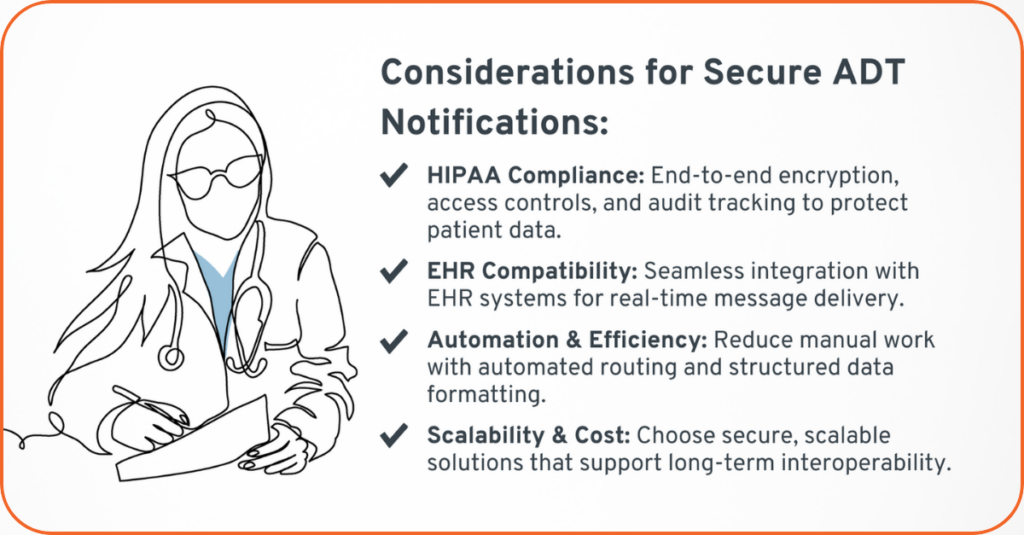
When selecting a secure, ADT notification solution, consider the following:
- HIPAA-Compliant Data Exchange: Ensure end-to-end encryption, access controls, and audit tracking to meet regulatory standards and protect patient data regardless of transmission method.
- System Compatibility & EHR Integration: Choose solutions that integrate seamlessly with different EHR systems, minimizing the need for custom development while ensuring real-time message delivery.
- Automation & Efficiency: Automated message routing, structured data formatting, and workflow integration reduce manual intervention, helping healthcare teams respond more quickly and effectively.
- Scalability & Cost-Effectiveness: The ongoing costs of managing secure FTP/VPN setups can be significant—organizations should evaluate scalable, secure messaging solutions that align with long-term growth and interoperability needs.
Best Practices for Managing ADT Notifications
For Healthcare Facilities Managing ADT Notifications
- Establish robust event-triggering protocols to ensure ADT notifications are consistently generated at critical care transition points.
- Leverage predictive analytics models by integrating ADT data with real-time risk assessments to prioritize follow-up care.
- Ensure structured ADT data formats are used for seamless EHR system interoperability, reducing data processing errors and delays.
- Implement DirectTrust-accredited Direct Secure Messaging to streamline ADT notification delivery, reducing reliance on complex VPN/SFTP configurations.
For Care Teams and Care Coordinators Using ADT Data
- Use ADT data analytics tools to gain real-time insights into patient transitions and readmission risks. This visibility is especially critical for care coordinators managing transitions, follow-ups, and ADT logistics across multiple providers.
- Train staff on how to interpret and act on ADT alerts, ensuring timely intervention and follow-up care.
- Adopt healthcare data dashboards to monitor ADT trends, track patient movement, and optimize care strategies.
- Incorporate AI-driven decision support systems to improve patient stratification and personalize intervention plans.
What the Future of ADT Data Analytics Means for Healthcare Organizations
As healthcare prioritizes interoperability, predictive analytics, and real-time decision-making, ADT data analytics will play an even greater role in improving patient care and operational efficiency.
Key Trends Shaping ADT Data Analytics
- AI-Powered Insights in Healthcare Data Systems: Advanced AI models are increasingly being used to enhance predictive analytics, making it easier to identify high-risk patients and optimize care coordination.
- Population Health Management & Value-Based Care: ADT data will drive community-wide care strategies, improving outcomes beyond individual encounters.
- Personalized Care Pathways: More organizations will leverage ADT data analytics to create tailored, proactive care plans for patients.
Final Thoughts
While ADT event notifications are now a regulatory requirement for many hospitals, analytics is where healthcare organizations unlock sustained operational and clinical value – provided they take a strategic approach to security, interoperability, and efficiency.
For organizations managing real-time patient data alerts across diverse networks, investing in reliable, scalable healthcare data management solutions will be critical to ensuring seamless data exchange, regulatory compliance, and improved patient care.
As healthcare information exchange continues its digital transformation, organizations that prioritize secure, efficient ADT notification management will be well-positioned to lead in data-driven care coordination.
Learn how DataMotion’s secure messaging solutions can optimize ADT workflows. Schedule a demo to explore seamless, real-time patient care coordination.
Frequently Asked Questions About ADT Data Analytics
What is ADT data in healthcare?
ADT data refers to admission, discharge, and transfer event information generated by healthcare systems when a patient moves through care settings. This data helps organizations track patient movement in real time, support care coordination, and trigger alerts for follow-up care, compliance, and operational monitoring. Read more about ADT Event Notifications and how to optimize them.
How do real-time ADT notifications improve care coordination?
Real-time ADT notifications provide immediate visibility into patient transitions, ensuring providers, care coordinators, and post-acute teams are informed at critical points in the care journey. This enables faster follow-ups, reduces communication gaps between organizations, and helps prevent missed care transitions.
What challenges affect ADT compliance and monitoring?
Common challenges include inconsistent data formats across EHR systems, delayed transmission through VPN or SFTP workflows, limited interoperability between networks, and the administrative burden of maintaining secure, compliant integrations. These issues can result in missed alerts and reduced visibility into patient movement.
How can healthcare entities improve compliance with automated alerts?
Healthcare entities can improve compliance by standardizing ADT message formats, automating routing and delivery, enforcing role-based access controls, and implementing audit logging. Secure, interoperable messaging solutions also help ensure ADT notifications are delivered in real time and meet HIPAA and CMS requirements.
What role do care coordinators play in managing ADT data?
Care coordinators rely on ADT data to monitor patient transitions, identify readmission risks, and coordinate timely follow-up care across providers. Effective ADT data analytics gives care teams the visibility needed to manage logistics, reduce gaps in care, and improve patient outcomes across complex networks.