

How a Major Wealth Management Firm Replaced a Critical Secure Messaging Platform Without Disrupting Client Experience
When a major wealth management firm faced the sudden end-of-life of its secure messaging platform, DataMotion helped replace it without disrupting the client-advisor experience, migrating 2TB of historical data and supporting a high-volume message center used by roughly 10,000 financial advisors.

Background
This project was conducted on behalf of a major financial services company known for its extensive asset management, advisory and insurance services. With more than $875 billion under management and administration, the wealth management firm’s network of roughly 10,000 financial advisors serves more than 2 million individuals, businesses and institutions across the globe.
Secure messaging had already become an important part of the firm’s client experience. Through its self-service portal, clients could securely exchange messages and documents with their financial advisors, with email and SMS notifications alerting them when new messages were available. Advisors and clients exchanged more than 800,000 messages through the system each year.
Challenges
The firm’s secure message center had become a critical part of the client-advisor experience, supporting more than 800,000 secure messages each year. Then, in early 2018, the global IT vendor behind the messaging technology announced that it would discontinue the product and end support.
With no adequate migration path available and a firm deadline approaching, the company needed to replace a mission-critical platform without disrupting the familiar experience used by clients and advisors. The replacement also needed to improve security and compliance, support the firm’s move to public cloud infrastructure and avoid an expensive wholesale replacement of the surrounding client services platform.
“We had a pretty tough date to meet. We knew we were going to have a very aggressive schedule and began looking at a lot of vendors,” said the company’s solution architect.
What the New Platform Had to Deliver
- Maintain and improve secure message center functions within the client services portal
- Keep the approach of using REST application program interfaces (APIs) for controlling the secure message center
- Migrate 2TB of client-advisor message data and attachments from the legacy system
- Provide access to migrated client-advisor message history in each active mailbox so clients would not see any difference
- Keep current active mailboxes, since a full “rip and replace” would be too costly
- Meet all compliance requirements in one of the most highly regulated industries
- Migrate the service to public cloud infrastructure without compromising security and performance
- Launch the new solution in 6-9 months
Secure Message Center
With no time to waste, the company immediately put out an RFI. The goal was to keep its basic infrastructure largely the same while switching to a new secure messaging solution – a “lift and shift.”
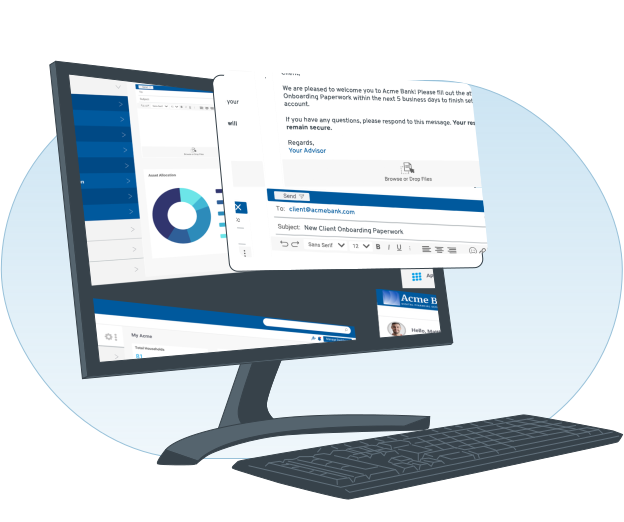
The deployment window for a project of this size was tight, to say the least. DataMotion was already on the company’s radar, and its experience integrating secure message center solutions through comprehensive APIs turned out to be the right fit. Unlike offerings from other vendors, DataMotion’s secure message center solution, deployed in Azure, met the firm’s requirements without forcing a wholesale replacement of its existing client experience.
DataMotion’s flexible secure messaging REST APIs were critical to swapping out the legacy messaging software. They allowed secure messaging and file transfer to continue operating within the firm’s existing infrastructure and webmail interface. Only the discontinued software needed to be replaced, avoiding the large-scale “rip and replace” of the portal and other critical enterprise infrastructure proposed by other vendors.
Deploying the system on Azure enabled DataMotion to take advantage of Microsoft technologies designed to support scalability and resiliency, including geo-redundant storage (GRS), site recovery for disaster recovery, load balancing and clustering.
DataMotion also deployed an advanced monitoring system to track system health and performance in real time, 24×7.
Secure messaging as a service is delivered through the DataMotion Platform, including the ability to link to separate systems for audit trails and compliance requirements as well as integrate with customer service systems.
“The best fit for us would be taking our existing services and swapping out the previous product logic that we communicated with – and that just wasn’t possible with other vendors,” explained the company’s solution architect. “With DataMotion, we could. We were able to still use our mailboxes and they had the APIs we needed to manage our message center. It was the ideal solution.”
The project required more than the right technology. DataMotion worked closely with both the company’s personnel and its systems integrator. When the company identified two areas where the solution needed additional functionality – importing messages and managing drafts – the teams collaborated to close those gaps.
“DataMotion said, ‘Alright, we’ll be able to do that, and in fact, those services actually make a lot of sense for our product,’” described the company’s solution architect. “That was one of the big drivers for us. DataMotion was willing to enhance the solution to make sure we had exactly what we needed.”

Advanced Monitoring
State-of-the-art monitoring deployed by DataMotion tracks system health and performance in real time, 24×7.

Secure Data Exchange
Integration supports audit trails and compliance requirements while connecting secure exchange with customer service systems.
Results
The transition achieved its most important goal: clients and advisors experienced essentially no disruption. The DataMotion solution successfully handled 10,000 messages between clients and advisors on its first day while preserving the familiar secure message center interface and user experience.
- Seamless client experience: Existing mailboxes, workflows and historical messages remained available to clients and advisors.
- Immediate scale: The new solution handled 10,000 client-advisor messages on its first day.
- Improved communications: Push notifications were integrated into the system.
- Automated compliance: Compliance reporting was tied into the solution and automated, requiring no additional effort from advisors.
- Cloud modernization: The project moved the company another step toward its long-term goal of eliminating on-premises solutions.
“DataMotion wanted us to be completely satisfied, and our teams worked hand-in-hand throughout it all,” said the company’s solution architect. “There were a few hiccups – which is to be expected with a project of this magnitude and complexity – but they always went the extra mile to resolve issues quickly.”
Business Impact
DataMotion’s approach delivered more than a technical replacement. Because the firm’s existing portal, mailboxes and user experience could remain in place, the organization avoided the costly wholesale “rip and replace” approaches proposed by other vendors.
Other replacement proposals would have cost millions of dollars to implement. DataMotion’s fit-for-purpose approach delivered the required functionality at a fraction of the cost while preserving the experience already familiar to clients and advisors.
- Lower implementation cost: Avoided multimillion-dollar rip-and-replace approaches proposed by alternative vendors.
- No retraining required: Advisors continued working within a familiar secure messaging experience.
- Reduced IT burden: The move to the cloud and DataMotion’s managed services model reduced ongoing maintenance requirements.
- Lower operational and security costs: The company reduced personnel, maintenance and security costs associated with supporting its secure message center service.
- Automated compliance: Reporting and compliance processes were integrated directly into the solution.
A Foundation for Secure Client Communications
The project demonstrated the value of treating secure communications as part of the broader client workflow rather than as a standalone security tool.
By integrating secure messaging and file exchange directly into the firm’s existing client experience, DataMotion enabled the organization to improve security and compliance without forcing advisors or clients into a new way of working.
The API-driven approach also created a flexible foundation the firm could extend as its digital client experience and secure communication requirements continued to evolve.