

Most regulated organizations don’t think they have a customer experience problem.
Secure messages get delivered. Compliance requirements are met. Audits pass. From an operational standpoint, things appear to be working as intended. Security is assumed — and in most cases, it should be.
In most organizations, that gap remains invisible until customers escalate, cases stall, or digital adoption plateaus.
And yet, day to day, something doesn’t quite add up.
Customers hesitate to respond. Messages surface in unexpected places. Portals don’t always reflect the same state. Simple interactions take more steps than they should. Internal teams compensate. Customers adapt. The friction becomes familiar enough that it stops drawing attention.
In regulated industries, secure messaging friction often goes unnoticed because the technology technically works — even when the workflow behind it makes the customer experience slower and harder than it should be.
That’s usually where the problem hides.
Not because anyone made a bad decision—but because many secure communication systems were built to prioritize control, not experience. And in regulated environments, control tends to win by default.
When Secure Messaging Works — But the Customer Experience Breaks Down
Secure messaging is a clear example of this tension.
Most enterprises already have it. Many have invested heavily to ensure it’s compliant, auditable, and secure. Those are table stakes. But far fewer step back and ask a more basic question: what does this actually feel like for the person on the other side?
How many steps does it take to open a message?
Where does the conversation live once it starts?
What happens when a form, a portal, and a message all touch the same interaction—but don’t quite line up?
These aren’t theoretical concerns. They’re practical ones. They show up in delayed responses, extra support effort, and small breakdowns that never rise to the level of an incident but quietly slow everything down.
The problem is that most reporting doesn’t capture this. Dashboards tell you whether systems are available and messages are delivered. They don’t tell you whether the experience makes sense. And when friction is consistent, it becomes invisible.
When friction becomes normal, it stops being questioned.
The impact becomes most visible at scale. What feels like minor inconvenience in isolated cases compounds across thousands of interactions — increasing resolution time, lowering digital adoption, and gradually eroding both customer satisfaction and operational efficiency.
What often gets missed is that the issue isn’t secure messaging itself.
It’s fragmentation.
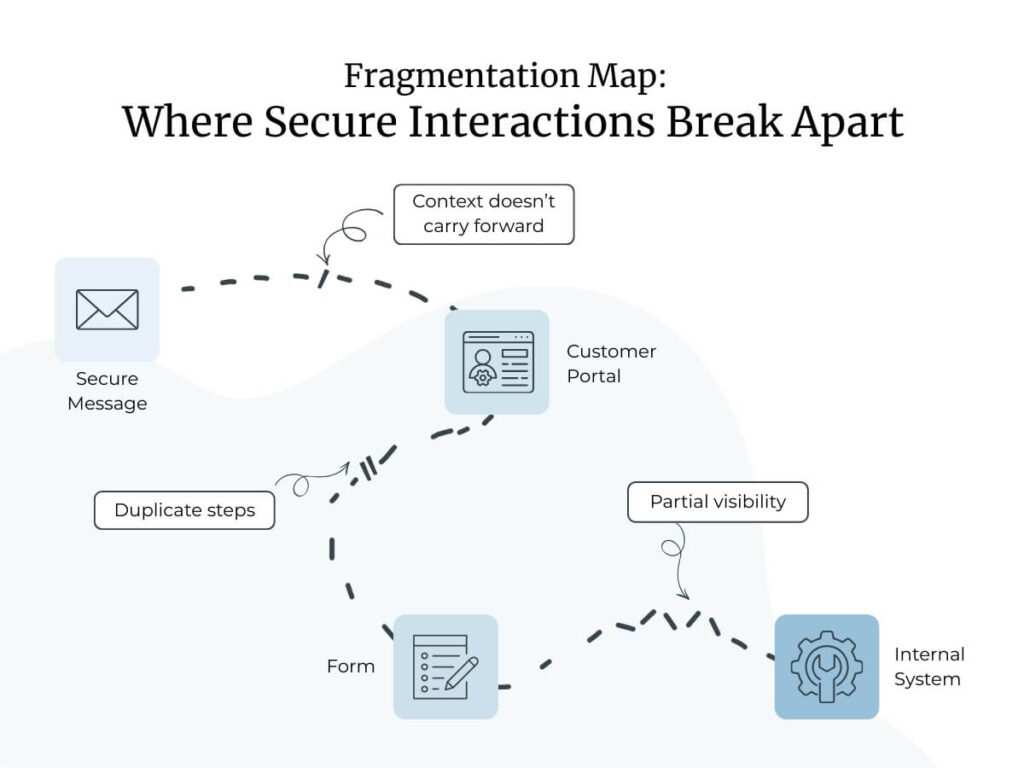
Messages, portals, forms, and internal systems may each work exactly as designed. But they’re rarely designed to work together as a single interaction. The result is an experience that technically functions while quietly breaking apart at the seams.
A message lives in one place. A form submission triggers something elsewhere. A portal shows part of the story, but not all of it. From the organization’s perspective, each system is doing its job. From the customer’s perspective, the interaction feels disjointed, repetitive, and harder than it should be.
This is how customer experience problems hide in plain sight. Not as failures, but as disconnects.
Why Secure Messaging Customer Experience Problems Persist in Regulated Organizations
For a long time, these gaps were easier to live with.
Secure interactions were slower, more linear, and often confined to a single channel. Customers tolerated extra steps. Internal teams absorbed the friction. The experience wasn’t elegant, but it was familiar.
That context has changed.
As organizations modernize CRMs, upgrade contact centers, and push more interactions into digital channels, the seams between systems are no longer hidden. Expectations have shifted. Interactions move faster. Conversations span more touchpoints. What once felt like minor inconvenience now shows up as hesitation, delay, and operational drag.
The same secure messaging models that once seemed sufficient are being asked to support far more connected, real-time experiences—and that’s where the strain starts to show.
In regulated organizations, there’s a natural assumption that a certain amount of complexity is unavoidable. Security requirements are real. Compliance obligations are non-negotiable. Some tradeoffs are expected.
The mistake is assuming that poor experience is one of those tradeoffs.
Over time, teams learn to work around the gaps. Customers learn what to expect. The organization adapts, and the system stays in place—not because it’s good, but because it’s familiar. The absence of loud complaints can easily be mistaken for success.
Customer experience problems rarely announce themselves all at once. They surface gradually, in ways that are easy to rationalize and hard to quantify. By the time they’re obvious, they’re often deeply embedded in workflows and processes.
That’s why many organizations don’t realize there’s an issue until they step back and look at the entire interaction, end to end.
The Hidden Cost of “Working” Secure Messaging – Especially at Scale
Secure messaging often meets compliance standards.
But when workflows fragment, the operational cost shows up elsewhere.
Across regulated environments, fragmented digital exchanges commonly result in:
- 10–20% longer case resolution times due to context switching
- Increased manual follow-ups when attachments or prior messages are not easily visible
- Higher escalation rates when customers cannot see the full conversation history
- Lower digital containment rates in contact centers
Individually, these inefficiencies seem minor.
At scale, they compound into measurable cost: agent time, customer frustration, and reduced workflow velocity.
Secure messaging may be technically compliant.
But compliance does not equal efficiency.
What Better Secure Messaging Customer Experience Actually Looks Like
What’s important to understand is that this isn’t an unsolvable problem.
Organizations that make progress here don’t loosen security controls or compromise compliance. They rethink how secure interactions are structured in the first place.
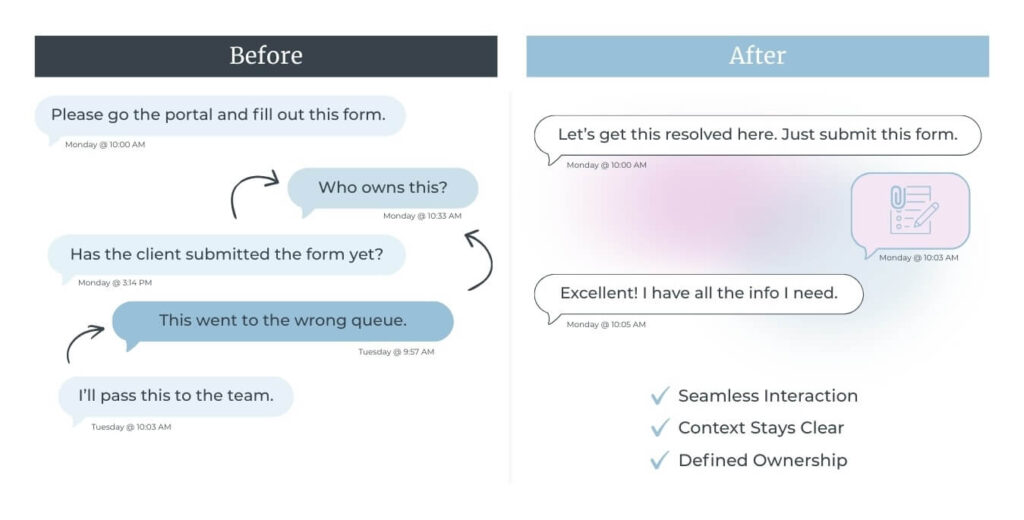
Instead of treating messaging, forms, and portals as separate moments, they design them as parts of a single, continuous interaction. Customers stay oriented. Context carries forward. Internal teams don’t have to reconcile disconnected systems after the fact.
Security remains intact — but it’s embedded directly inside core workflows instead of layered on as a detached add-on.
In these environments, security no longer feels like a detour. It becomes part of the flow.
The difference isn’t better enforcement. It’s fewer fractures.
The First Step Isn’t Fixing — It’s Noticing the Experience
This isn’t a call to rip anything out or change platforms overnight. It’s not even a call to solve the problem yet.
It’s a prompt to notice it.
To pay attention to how secure interactions actually unfold across portals, forms, and workflows. To observe where customers hesitate, where teams intervene, and where work quietly slows down. To recognize that secure and usable are not mutually exclusive—even in regulated environments.
Organizations that do this well don’t start with tools. They start with awareness. They name the problem clearly before they try to address it.
If any of this feels familiar, you’re not alone.
More regulated organizations are beginning to take a closer look at the experience their secure communication workflows create—not because something failed, but because something never worked as smoothly as it should have.
You don’t need to fix anything yet.
But once you start seeing secure messaging as part of a broader interaction — not a standalone system — it becomes harder to ignore where things break down.
The organizations that make progress here don’t start with rip-and-replace initiatives. They start by rethinking how secure messages, forms, portals, and workflows fit together as a single experience — for customers and internal teams alike.
That shift changes the conversation.
In the next piece, we’ll explore what happens when secure messaging is designed as part of a connected interaction — and why that approach is becoming increasingly important as regulated organizations modernize their customer and advisor experiences.
You just need to see it—because once you do, it’s hard to unsee.
For organizations investing heavily in CRM consolidation, cloud migration, or digital transformation initiatives, fragmented secure messaging introduces a silent contradiction: systems modernize, but experiences remain disconnected. When workflow breaks are overlooked, transformation efforts succeed architecturally while friction quietly limits satisfaction, efficiency, and scale.
Frequently Asked Questions
What is a secure messaging customer experience problem?
A secure messaging customer experience problem occurs when messages are delivered securely but the interaction is difficult for users—requiring multiple logins, fragmented portals, or unclear workflows that slow response and create friction.
Why don’t secure messaging experience issues show up in reporting?
Most reporting focuses on delivery, uptime, and compliance. Experience friction—extra steps, confusion, and workarounds—is consistent enough that it becomes normalized and invisible to traditional metrics.
Is poor customer experience unavoidable in regulated industries?
No. While regulatory requirements add complexity, poor experience is not required. Many issues stem from fragmented workflows rather than compliance itself.
How can organizations identify secure messaging experience issues?
The first step is observing how customers and internal teams actually interact with secure messages across portals, forms, and workflows—rather than relying solely on system-level metrics.
About the Author
Anne Marie Murray
Anne Marie Murray is Head of Marketing at DataMotion, where she leads brand, demand generation, product marketing, partner marketing, and go-to-market strategy. With more than 20 years of experience in B2B technology and SaaS, she brings deep expertise in translating complex enterprise products, secure communications, and regulated-industry workflows into clear market strategies and measurable business value. Her background spans market research, positioning, product launches, sales enablement, AI-enabled marketing, and revenue growth. As a member of DataMotion’s leadership team, Anne Marie partners across product, sales, and engineering to turn customer insight, market opportunity, and technical capabilities into strategies that strengthen adoption, pipeline, and long-term growth.